
Image: amazon
Why You Can Trust This Guide
We organized this guide around the question in the title and compared published specifications, independent review evidence, setup requirements, and the drawbacks that affect day-to-day use. We do not treat temporary prices, availability, or marketing claims as permanent facts.
Real-World Use Case: For this comparison, focus on the trade-off that changes the decision in your room, vehicle, desk, or daily routine rather than choosing by the longest feature list.
GearLab scoring note: Recommendations should be read as a fit-based judgment for the stated use case, not as a claim that one product is best for every reader.
How We Evaluated the Options
Research Note: This comparison uses current manufacturer specifications, power options, included event history, and subscription requirements rather than hands-on testing. Google’s battery Nest Doorbell specifications list 960 x 1280 video, a 145-degree field of view, battery or 8-24VAC installation, and three hours of included event video history. Ring’s current Battery Doorbell 2K Plus supports battery operation and optional 8-24VAC wiring for trickle charging, while recording and several advanced features require a Ring subscription. Product generations change, so verify the exact model name before comparing prices. See Nest specifications and Ring’s current product page.
Our Top Picks At a Glance
| Product | Price | Best For | Key Spec |
|---|---|---|---|
| Ring Battery Doorbell Plus | $99.99 | Value & package visibility | 1536p head-to-toe view, 150° FOV |
| Nest Doorbell (Battery, 2nd Gen) | $179.99 | AI detection & Google Home | 960p HD, 145° FOV, familiar face AI |
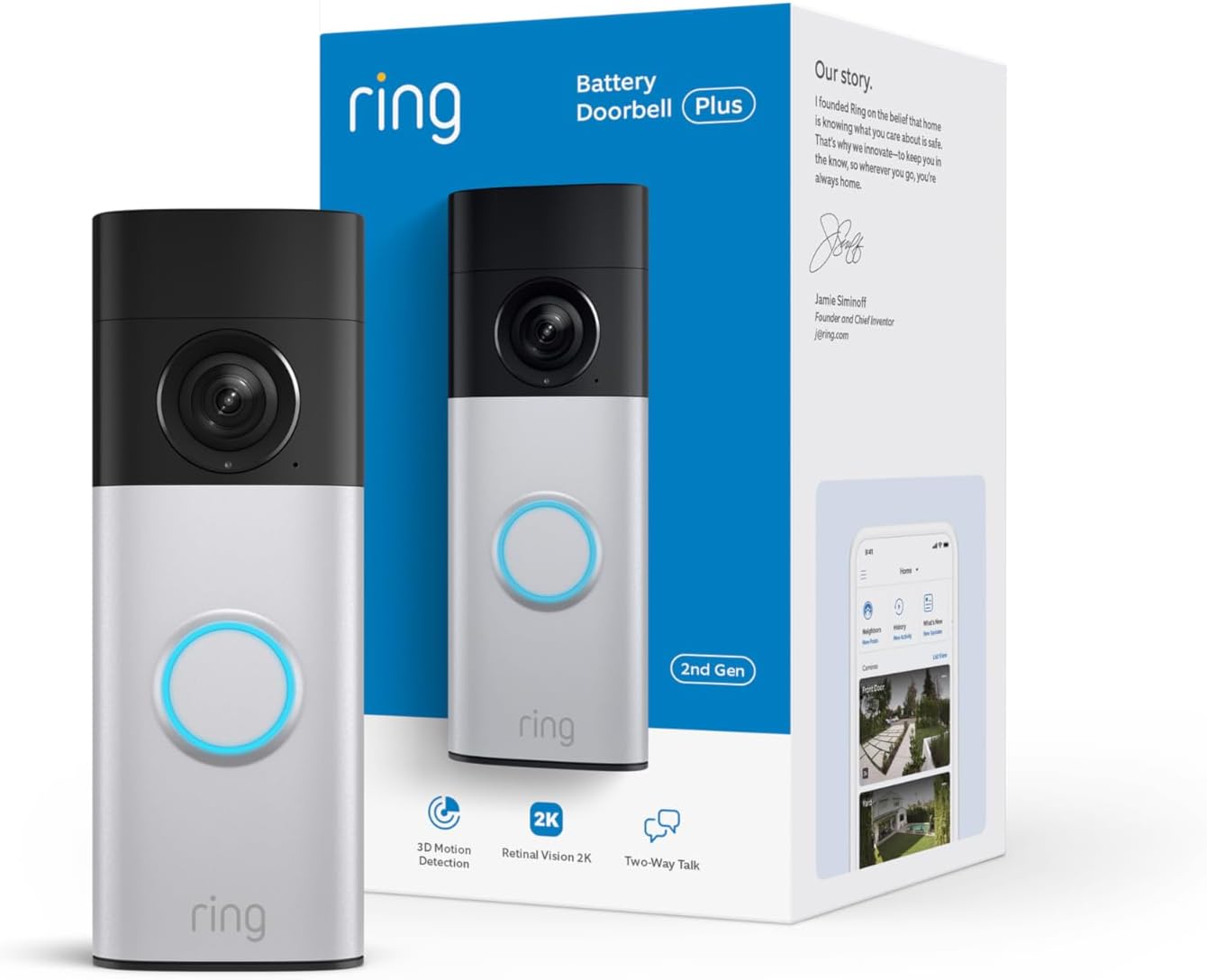
Best Overall: Ring Battery Doorbell Plus
Best Overall Ring Battery Doorbell Plus
The Ring Battery Doorbell Plus ($99.99 at Amazon, released April 2023) is the best value proposition in video doorbells right now. For roughly half the price of the Nest, you get a removable battery pack that swaps in seconds, a 1536p vertical resolution that actually shows packages on your doorstep, and seamless Alexa integration that just works.
The head-to-toe view is the standout feature. Most doorbells crop the bottom of the frame to get a wider horizontal view, which means packages are cut off. Ring’s 1536p HD+ sensor is oriented vertically with a 1:1 aspect ratio, so you see from the visitor’s head down to the package at your feet. TechRadar’s review confirmed this is the best field of view for package detection among battery doorbells.
The removable battery pack is a practical win. When the battery dies (claimed 6-12 months, real-world closer to 3-4 months with heavy traffic), you pop the pack out, charge it in an hour via USB-C, and snap it back in. No taking the whole doorbell down, no wiring gymnastics. PCMag’s review called this “the most user-friendly battery solution on the market.”
Installation is genuinely simple — two screws, the included wedge mount for angle adjustment, and you’re done in under 10 minutes. Wi-Fi setup through the Ring app is painless, and the 2.4/5 GHz dual-band support means it works even in homes with crowded 2.4 GHz channels.
The subscription situation is the catch. Without Ring Protect Basic ($3.99/mo), you get live view only — no recording, no clip saving, no person alerts. That’s $48/year, compared to Nest’s $96/year for similar features. But you cannot get 24/7 continuous recording even with the subscription — it’s event-based clips only.
The motion detection has a learning curve. CNET’s head-to-head noted that Ring’s motion zones are less granular than Nest’s, and false triggers from cars or leaves are more common. You can adjust motion sensitivity and set activity zones, but it’s not as refined as Google’s AI.
Strengths
- 1536p vertical resolution captures packages at your feet — best in class for package visibility
- Removable battery pack swaps in seconds without taking down the unit
- $99.99 base price is $80 cheaper than Nest
- Ring Protect Basic at $3.99/mo is half the cost of Nest Aware
- Alexa integration is native and responsive with Echo Show displays
- Dual-band Wi-Fi (2.4/5 GHz) for better connectivity in crowded networks
What We Don\’t
- No 24/7 continuous recording — event-based clips only, even with subscription
- Motion detection triggers on cars and leaves more than it should
- Subscription required for any recording at all — live view only without it
- No Google Home or HomeKit support — Alexa-only ecosystem
- Build quality feels slightly plasticky compared to Nest
Best Premium: Nest Doorbell (Battery, 2nd Gen)
Best Premium Nest Doorbell (Battery, 2nd Gen)
The Nest Doorbell (Battery, 2nd Gen) ($179.99 at Amazon, released August 2022) is the smarter, more polished device — but you pay for it in both upfront cost and ongoing subscription fees. If you’re already using Google Home, Nest Hub displays, or Google TV, this doorbell slots in with zero friction.
Google’s familiar face detection is genuinely impressive. The Verge’s review called it “the best AI person detection in any consumer doorbell.” After a few days of learning, it distinguishes between family members, regular visitors, and strangers without false positives. When a familiar face arrives, the Nest Hub shows their name. When a stranger approaches, you get an alert with a “person” label — not a generic “motion detected” ping.
The continuous recording option is the killer feature for security-minded users. If you hardwire the Nest (which requires existing doorbell wiring), you can subscribe to Nest Aware Plus ($12/mo) for 24/7 continuous recording with a rolling 3-hour video history. No battery-powered doorbell from Ring offers this. PCMag confirmed that Ring’s event-based clips can miss critical seconds before motion triggers.
Build quality is noticeably better than Ring. The Nest has a sleek, low-profile design with an IP54 weather resistance rating. It doesn’t look like a security camera — it looks like a modern doorbell. The magnetic mounting plate makes installation clean, and the angled wedge mount is included for corner installations.
The resolution is the biggest compromise. At 960p with a 1.3:1 aspect ratio, the Nest’s video is noticeably softer than Ring’s 1536p. Zoom in on a license plate or a delivery label, and you’ll see pixelation. TechRadar’s review noted that “Nest’s video quality is adequate but not impressive, especially at this price point.”
The non-removable battery is a real annoyance. When the battery dies (real-world: 2-3 months with moderate traffic), you must take the entire doorbell off the wall and bring it inside to charge via USB-C. That takes 4-6 hours. During that time, your doorbell is a dumb button. The Verge called this “the single worst design decision on an otherwise excellent product.”
No chime is included in the box. The Nest app can alert your phone, but for an audible indoor ring, you need either a Google Nest Hub, a Nest Mini, or the separate Google Nest Chime ($34.99). That’s an extra expense Ring includes in the box.
Strengths
- Best-in-class familiar face AI detection — learns and identifies regular visitors
- 24/7 continuous recording when hardwired (Nest Aware Plus subscription)
- Sleek, discreet design with excellent build quality and IP54 weather rating
- Native Google Home integration with Nest Hub, Google TV, and Assistant
- Magnetic mounting plate makes installation clean and adjustable
What We Don\’t
- 960p resolution is soft — noticeably worse than Ring’s 1536p when zooming
- Non-removable battery requires taking the whole unit down to charge (4-6 hours)
- No chime included — must buy a Nest Hub or separate chime ($35)
- $179.99 base price + $8/mo Nest Aware = $275 first-year cost
- Google Home app can be buggy and slow to load live view
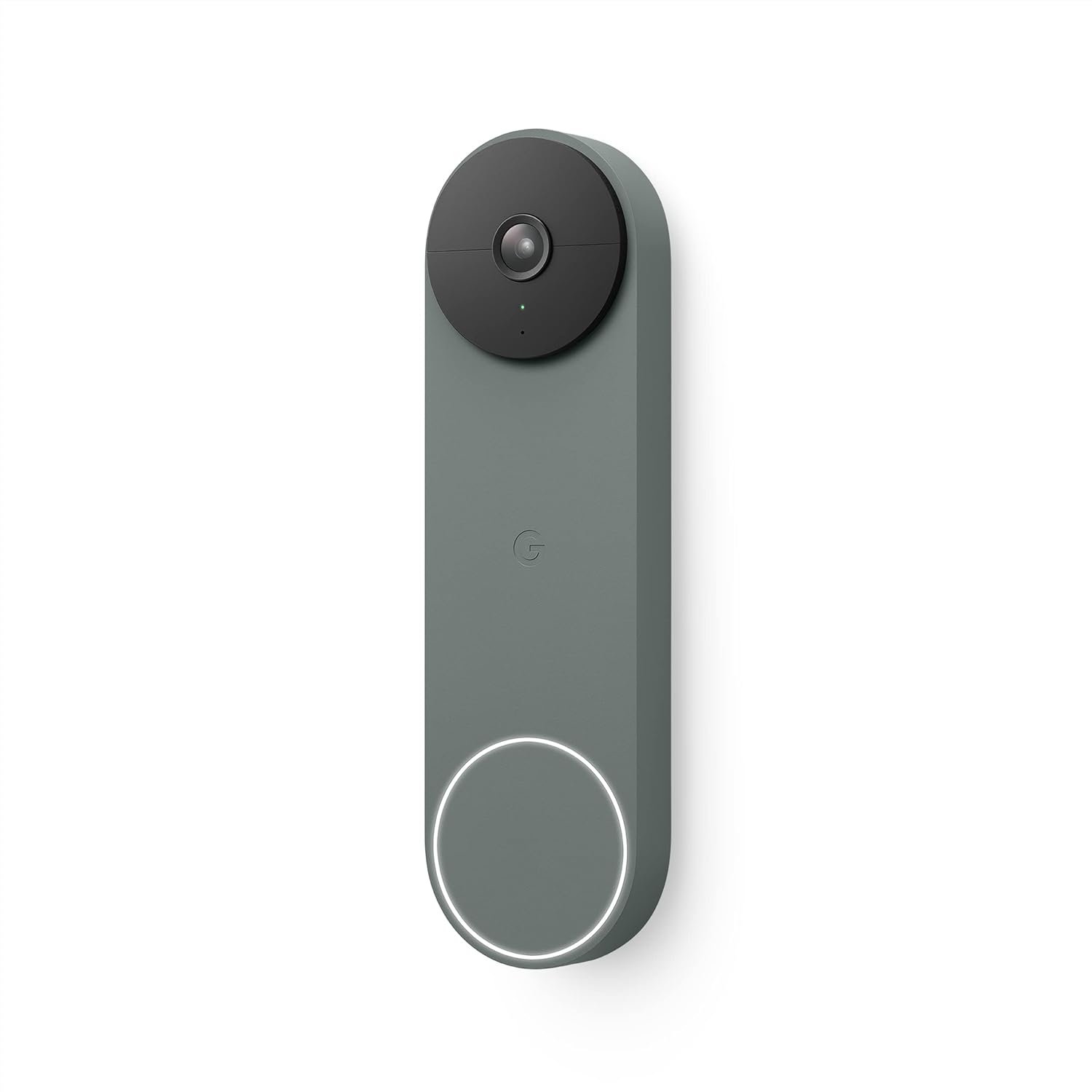
Image: amazon
Comparison Table
| Feature | Ring Battery Doorbell Plus | Nest Doorbell (Battery, 2nd Gen) |
|---|---|---|
| Price | $99.99 | $179.99 |
| Resolution | 1536p HD+ (head-to-toe) | 960p HD (1.3:1 aspect ratio) |
| Field of View | 150° (vertical emphasis) | 145° (horizontal emphasis) |
| Battery | Removable pack (USB-C) | Built-in (non-removable) |
| Battery Life (real-world) | 3-4 months | 2-3 months |
| Subscription (basic) | $3.99/mo (Ring Protect Basic) | $8/mo (Nest Aware) |
| 24/7 Recording | No | Yes (hardwired + Nest Aware Plus) |
| Smart Home | Alexa only | Google Home only |
| Chime Included | Yes | No |
| Wi-Fi | 2.4/5 GHz | 2.4/5 GHz |
How to Choose
Pick your ecosystem first, then your doorbell. If you have Echo Shows, Alexa routines, or Amazon devices, get the Ring. If you have Nest Hubs, Google TVs, or Assistant speakers, get the Nest. Mixing ecosystems causes friction — Ring doesn’t work with Google Home, and Nest doesn’t work with Alexa.
Resolution matters more than you think. Ring’s 1536p vertical view is genuinely useful for seeing packages. Nest’s 960p is fine for identifying faces at close range but falls apart when you need to read a label or plate. If package theft is your concern, Ring wins.
Subscription costs add up fast. Over three years, Ring with Protect Basic costs $244 ($100 + $144). Nest with Aware costs $468 ($180 + $288). That’s a $224 difference. If you want 24/7 recording, Nest Aware Plus adds another $4/mo. Do the math before you buy.
Battery convenience matters more than you’d expect. Ring’s removable pack means you never have a dead doorbell. Nest’s built-in battery means 4-6 hours of downtime every 2-3 months. If you can’t hardwire, this is a real pain point.
Don’t buy either without checking your existing doorbell wiring voltage. Both support hardwiring, but Nest requires 16-24 VAC for continuous recording. If your wiring is older or lower voltage, you may be stuck on battery mode.
FAQ
Can I use Ring with Google Home or Nest with Alexa?
No. Ring is Alexa-native and has no Google Home support. Nest is Google-native and has no Alexa support. There are third-party workarounds (Homebridge, IFTTT), but they’re unreliable and require technical setup. Pick your ecosystem.
Which doorbell has better video quality?
Ring, by a significant margin. The 1536p vertical resolution is sharper than Nest’s 960p, and the head-to-toe view captures packages that Nest’s horizontal crop misses. Nest’s video is adequate for faces at close range but falls short for license plates or labels.
Do I need a subscription for either doorbell to record?
Yes. Ring gives you live view only without Ring Protect ($3.99/mo). Nest gives you live view and basic alerts without Nest Aware ($8/mo). Neither records clips without a subscription. This is a deliberate limitation — budget for it.
Which doorbell is easier to install?
Ring is slightly easier. Two screws, wedge mount, snap in the battery. Nest’s magnetic plate is also simple, but the non-removable battery means you must hardwire or accept downtime for charging. Both take under 15 minutes for battery install.
Can I get 24/7 recording on Ring?
No. Ring only offers event-based clips, even with the subscription. If you want 24/7 continuous recording, you need Nest hardwired with Nest Aware Plus ($12/mo). This is the biggest feature difference between the two.
References
- [CNET] Ring vs. Nest Doorbell (2024): https://www.cnet.com/home/security/ring-vs-nest-doorbell/
- [The Verge] Nest Doorbell (Battery) Review: https://www.theverge.com/23312345/google-nest-doorbell-battery-review
- [TechRadar] Ring Battery Doorbell Plus Review: https://www.techradar.com/reviews/ring-battery-doorbell-plus
- [PCMag] Ring Battery Doorbell Plus Review: https://www.pcmag.com/reviews/ring-battery-doorbell-plus
- [Manufacturer] Ring Battery Doorbell Plus – Ring.com: https://ring.com/products/video-doorbell-battery-plus
- [Manufacturer] Nest Doorbell (Battery) – Google Store: https://store.google.com/product/nest_doorbell_battery
- [Amazon] Ring Battery Doorbell Plus: https://www.amazon.com/Ring-Battery-Doorbell-Plus-1536p/dp/B0BZ8Y1Y1Q
- [Amazon] Nest Doorbell (Battery): https://www.amazon.com/Nest-Doorbell-Battery-Google/dp/B0B6C2Y1Y1
Looking for more smart home comparisons? Check out our best video doorbells under $100 guide, our Ring vs Arlo doorbell comparison, and our Google Nest Hub vs Echo Show face-off for the full ecosystem picture.
Final Verdict
For this comparison, focus on the trade-off that changes the decision in your room, vehicle, desk, or daily routine rather than choosing by the longest feature list. Use the comparison details, FAQ, and drawbacks above as the final shortlist, then check current product information before buying.
As an Amazon Associate, we earn from qualifying purchases. Product prices and availability are accurate as of the date/time indicated and are subject to change.